The physics were always there. No one had used them.
Every moving train generates enough kinetic energy to clean its own rail. AirflowRail is the device that makes it happen — passively, continuously, without consuming a single watt.
How AirflowRail works
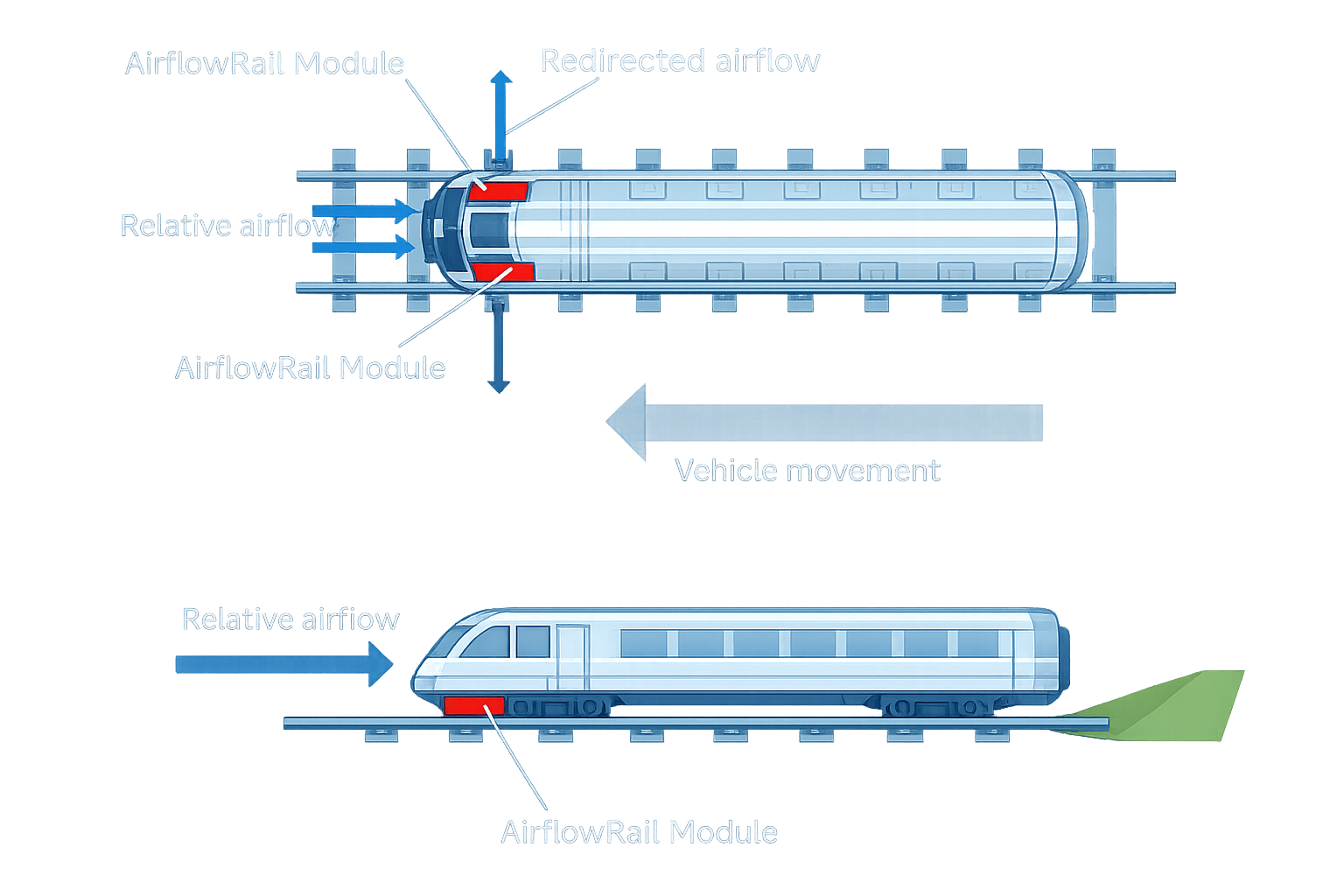
A compact tube, mounted on the bogie. No motor. No sensor. No power supply.The device captures the airflow naturally generated by the train's movement, amplifies it ×11 through a converging nozzle, and redirects a high-velocity jet onto the rail surface — before the wheel arrives.The faster the train, the more effective the device.
⚡
No energy
100% passive
🔧
No electronics
Zero complexity
🛡️
No maintenance
Long service life
⚛️
Just physics
Optimized
The Hidden Problem Undermining Rail Performance
Environmental deposits cause a cascade of operational issues: Direct Effects • Loss of adhesion • Wheel slip and slide • Longer braking distances • Reduced traction Operational Consequences • Delays, cancellations, and degraded punctuality • Increased safety risks and operational incidents • Higher energy consumption • Premature wear of wheels, rails, and exposed components • Rising maintenance costs • Damage to brand reputation
Railway operators know the problem. Until now, they simply lacked a preventive solution.
Direct effects
Loss of adhesion
Wheel slip and slide
Longer braking distances
Reduced traction
Operational consequences
Delays & cancellations
Increased safety risks
Higher energy consumption
Premature wear & rising costs
Why Current Solutions Fall Short
Today’s methods are mostly reactive: • Frequent cleaning of tracks and rolling stock • Rail and wheel reprofiling • Costly active systems (sensors, sprayers, electromechanical devices) • Chemical treatments with environmental impact • Heavy mechanical protections • High labour requirements
Their limitation is fundamental: they act after the wheel–rail contact — too late to prevent adhesion loss.
Reactive
Cleaning, reprofiling, sprayers, chemicals — all act after the problem occurs. Too late to prevent adhesion loss. High cost, low impact.
AirflowRail
Acts before the wheel–rail contact. Preventive, passive, zero energy. Cleans the rail surface continuously while the train is in motion.
A device that works ahead of the problem
How it works — 5 steps
1
Natural airflow capture
The device intercepts part of the airflow generated by the moving train.
2
Optimized internal geometry
The tube shapes this airflow into a stable, controlled stream — amplifying pressure ×11.
3
Redirection to critical zones
The airflow prevents deposits from settling and reduces slippery film formation.
4
Action upstream of wheel–rail contact
The breakthrough: the device prepares the rail surface before the wheel arrives.
5
Operational impact
Better adhesion · fewer slip events · lower energy use · zero watt consumed.
Key Advantages for Operators and Manufacturers
Improved adhesion
Cleaner rail → better traction → lower energy use.
Higher performance
Fewer disruptions, fewer losses, more reliability.
Zero energy
A passive, robust, long-life solution. No power required.
Lower maintenance
Less wear, fewer interventions, fewer failures.
Universal compatibility
Humid, desert, industrial, temperate — all environments.
Easy integration
New rolling stock or retrofitting existing fleets.
Designed for Global Rail Challenges
🌧
Humid climates
Europe, North America — leaves, moisture, biofilm
🏜
Desert regions
Middle East, North Africa — sand, fine dust
🏭
Industrial zones
Metallic dust, chemical residues
🚄
High-speed lines
High sensitivity to adhesion variations
🚇
Urban & metro
Frequent stops — traction becomes critical
100%
Universal
A Simple, Universal, Game‑Changing Innovation
AirflowRail Innovation delivers what the rail industry has been missing: a preventive, passive, and scalable solution to a global operational problem. • Efficient • Economical • Ecological • Compatible with every network.
AirflowRail continues to pioneer new applications in airflow management, energy efficiency, and railway safety — shaping the future of rail mobility.